Q&A: What is the Brazil-led ‘deforestation roadmap’?
Summary
Brazil's COP30 presidency has published a voluntary "deforestation roadmap" to halt and reverse forest loss, but it sits outside the formal UN outcome and makes no new commitments.
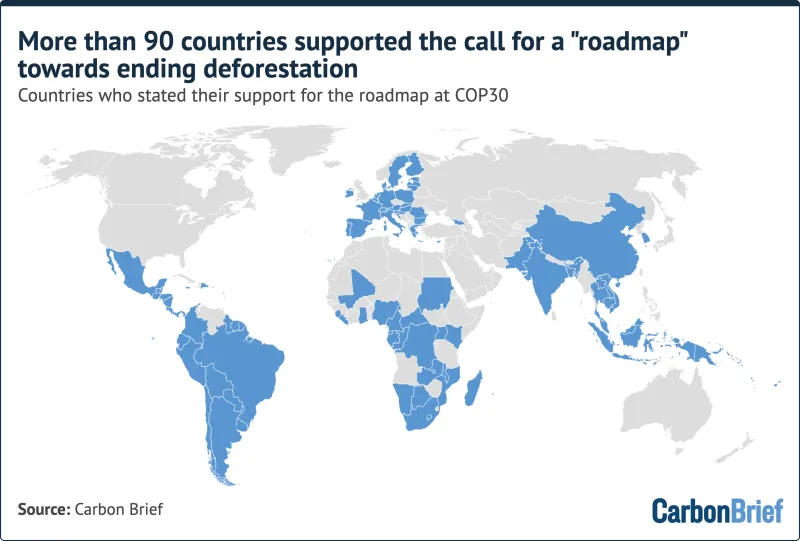
The roadmap, released on 3 November, grew from a proposal by President Luiz Inácio Lula da Silva ahead of the Belém summit. By the end of COP30, 93 countries had signed on to develop voluntary pathways to reverse forest loss and degradation by 2030. That fell well short of the 196 parties needed for consensus, so COP30 president André Corrêa do Lago said the presidency would pursue the roadmap outside the COP process.
The document divides action into national, international and financial measures. It lists 18 policy approaches, such as protected areas and recognising Indigenous land rights, and proposes a five-step process for countries. It estimates that $300bn per year is needed by 2030, yet current finance covers less than a third of that, with nearly 90% coming from domestic public budgets.
Several countries held back. India objected to voluntary roadmaps outside the COP agenda, but its environment minister later said it "welcomes" the roadmap. Russia said it "does not support the development of a universal roadmap" and opposed it on trade grounds. The roadmap's coordinator argued that no further signatures are needed, because countries already accepted the goal of halting deforestation by 2030 in the global stocktake and the Kunming-Montreal biodiversity framework.
Key points
- The roadmap was released on 3 November and makes no new commitments.
- 93 countries signed on by the end of COP30, short of the 196 needed for consensus.
- The presidency will pursue the roadmap outside the formal COP process.
- Estimated need is $300bn per year by 2030; current finance is under one-third of that.
- India and Russia raised objections; Russia opposed it on trade grounds.
- The roadmap follows earlier pledges from 2014, 2021 and 2023 to end forest loss by 2030.
Why it matters
Brazil reports its deforestation rate has fallen by more than 70% since 2022, and the roadmap is meant to be a "living document" guiding country-led action. Its success will depend on whether countries close the large gap in forest finance.
- deforestation
- COP30 climate talks
- forest finance
- forest degradation policy
Coverage
source covering this story
1 independent source
Q&A: What is the Brazil-led ‘deforestation roadmap’?
On 3 November, the Brazilian presidency of the COP30 climate talks released its long-awaited “roadmap” on ending deforestation. Ahead of… The post Q&A: What is the Brazil-led ‘deforestation roadmap’? appeared first on Carbon Brief.
Q&A: What is in the global ‘roadmap’ for transitioning away from fossil fuels?
Transitioning away from fossil fuels is “urgent, inevitable and, yet, possible”, according to a first-of-its-kind global “roadmap” produced by Brazil.… The post Q&A: What is in the global ‘roadmap’ for transitioning away from fossil fuels? appeared first on Carbon Brief.